What a Key Copy Costs in NYC, and Why Some Keys Cost More
A key copy in NYC costs $30 to $85 per key, depending on the blank. The gap comes from the key, not the machine: a plain brass house key is a minute at a kiosk, and a restricted high-security key cannot be copied at a kiosk at any price.
This guide prices each kind of key honestly, explains why the "Do Not Duplicate" stamp does not stop anyone, and covers the cases where a copy has to come from the dealer.
What each kind of key copy costs
The price follows how hard the blank is to cut and who is allowed to cut it.
| Key type | Typical cost | Who can copy it |
|---|---|---|
| Standard brass house or apartment key | Low end of $30 to $85 | Any locksmith or kiosk |
| Restricted or high-security key | Higher end of $30 to $85 | Authorized dealer only, with authorization |
| Mailbox key | Per key, quoted | Depends on whose lock it is |
| Car key or fob | See our car key cost guide | Locksmith with programming equipment |
Walking into a hardware store for a standard key can be cheaper than a locksmith visit, and for a plain brass key that is a reasonable choice. A locksmith earns the price when the key is not plain, when you need it cut on site, or when you cannot get to a shop at all.
Why a "Do Not Duplicate" stamp does not work
Plenty of keys are stamped "Do Not Duplicate," and the stamp is a request, not a lock. A kiosk that stocks the blank can cut the key whatever it says, and many do, because the person at the counter is paid to sell copies and cannot verify who owns the door.
That matters most for apartment and office keys. A key that opens your door can be copied in a minute by anyone who holds it for that long: a contractor, a dog-walker, a previous tenant. Stamping it does nothing. The only things that stop a copy are a keyway the kiosk does not stock and an authorization step before a dealer will cut it.
High-security keys: why most places turn you away
A restricted key belongs to a patent-protected system, and the blank is not sold over the counter. Each cylinder is keyed to a unique blank, and the people allowed to order a copy are the owner, or someone with the owner's written authorization plus a notarized signature card on file with the dealer.
That is why the copy costs more and takes longer than a kiosk key. It is also the entire point of owning the system. The detail is in high-security key duplication in NYC, including what to bring so you only make one trip, and the system behind it is described on the high-security locks page.
Cutting a key on site
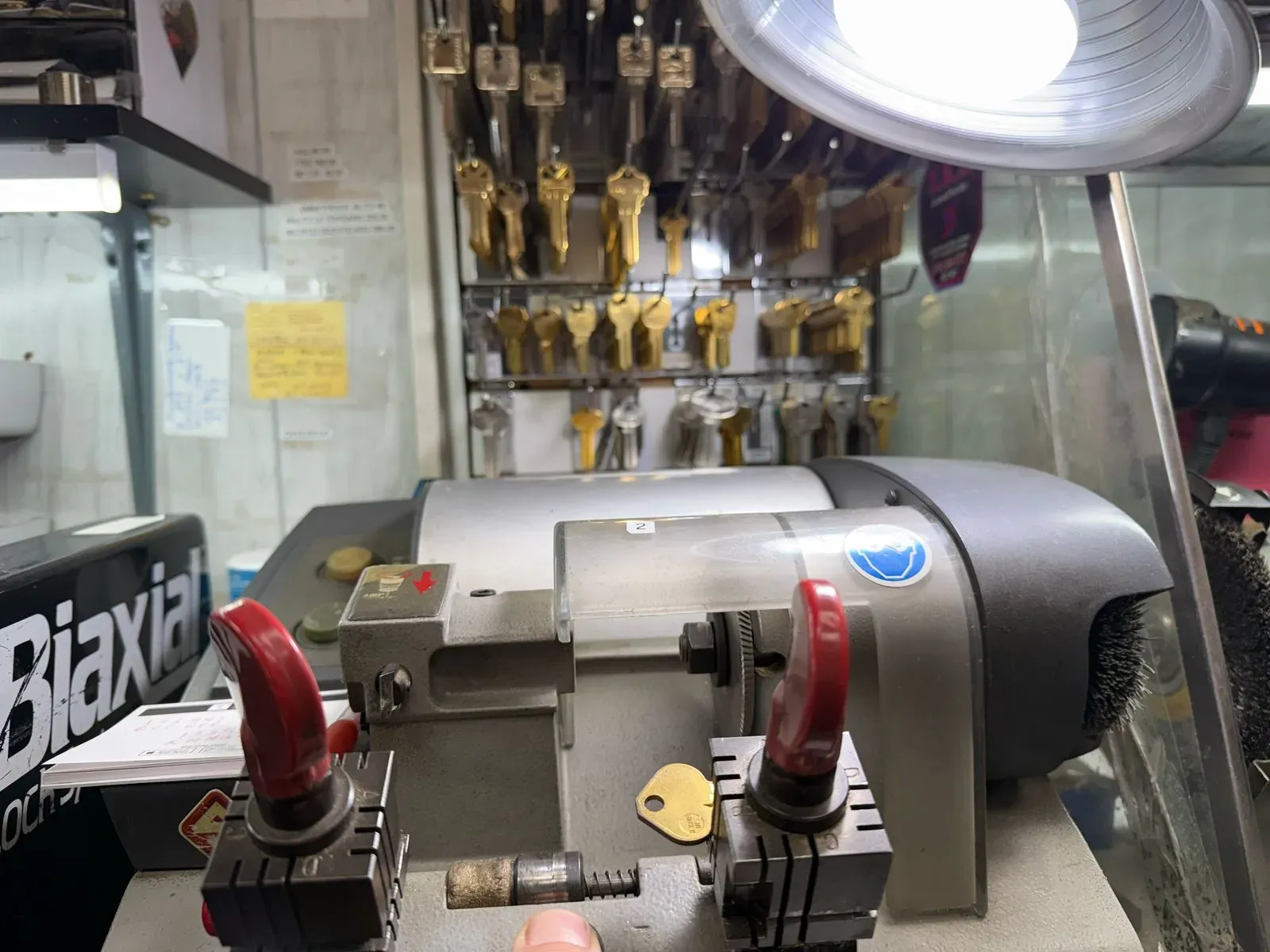
Our mobile units carry key-cutting machines, so a copy can be cut at your door instead of at a shop. That is the right choice in three situations: you are locked out and the spare is inside with someone who is home, you need keys for a whole office, or you are rekeying and want the new keys cut as part of the same visit.
On-site cutting is priced as part of a visit, which means the service call applies: $65 during business hours (8 a.m. to 6 p.m.), $125 after hours (6 p.m. to 2 a.m.), $195 late night (2 a.m. to 7 a.m.). For a single plain key, a kiosk is cheaper. For six keys on a rekey, one visit is cheaper than six trips. The mobile locksmith service page lists what the units carry.
Key copies that are not house keys
Several keys look like ordinary keys and are not.
Mailbox keys are the first. The mailbox lock may belong to the building or to the postal service, and whoever owns it decides who can copy the key, a point covered in mailbox lock replacement in NYC. Car keys are a different job entirely, since a transponder chip has to be programmed to the car, and the numbers are in spare car key copy cost. Building fobs are electronic credentials and are controlled by whoever runs the building.
Know which one you hold before you shop for a price, because the cheap answer for one is the wrong answer for another.
How to avoid paying twice
Three habits keep copies cheap. Cut the spare while you still have a working key, since a copy from an original is simpler than a key made from the lock. Check that the copy turns in your lock before you leave, and again at home, because a bad cut is far easier to fix while you are still standing at the counter. And keep a count: if you cut four keys, you should be able to say who holds each one.
If you lose track, the cleaner fix is a rekey, not more copies, and the comparison is in rekey or replace your locks. A key duplication request that comes with a rekey is usually the cheapest way to end up with a known set of keys.
A copy that does not work
A copy fails because the cut is slightly off, and a key that is a hair out will turn on a good day and jam on a bad one. Test it before you pay, in the lock it is meant for if you can, several times in both directions. If it sticks, have it recut instead of working it in by force, because forcing a stiff key is how a good cylinder gets worn.
A worn original makes a worn copy. If your key has been smoothed down by years of use, a copy cut from it carries the wear. Ask the shop to cut from a fresh blank and check the result against the lock, and if the lock itself is dragging, the fix is a rekey or a new cylinder, not another copy.
Red flags at a kiosk
A few signs say a copy will not be right. Nobody tests it. Nobody asks what kind of key it is before quoting. The price is the same for every key you hand over, whatever the blank. Or you are told a restricted key can be copied on the spot, which means either it is not restricted or the counter is cutting something it should not.
How many copies you should have
A workable rule is one key you carry, one spare kept at home, off the ring and not under the mat, and one with a person you trust. More than that and you cannot say where they all are. If you have lost count, a rekey resets the count to the keys in your hand, which is cheaper than finding out later.
For tenants, the owner's lock belongs to the owner, and copies are normally made from the keys you were issued. For offices, a written key log, with names and dates, is what makes a lost key a small problem and not an unknown one.
Frequently Asked Questions
How much does it cost to copy a key in NYC? Key copies run $30 to $85 per key depending on the blank, with a standard brass key at the low end and restricted high-security keys at the high end.
Can any locksmith copy a "Do Not Duplicate" key? The stamp has no force. A kiosk or locksmith that stocks the blank can cut it. Restricted high-security keys are different: those blanks are controlled and need authorization.
Why can't I copy my high-security key at a kiosk? The blank is patent-protected and sold only through authorized dealers, who require written authorization and a notarized signature card before cutting a copy.
Is it cheaper to copy a key or rekey the lock? A single copy is cheaper. If you are copying because keys are loose, such as a lost set or a former tenant, a rekey is cheaper than chasing copies.
Can you cut a key at my door? Yes. Our mobile units carry key-cutting machines. The service call applies, so a single plain key is cheaper at a kiosk and several keys are cheaper in one visit.
Need Expert Help?
If you have questions about any of the security solutions discussed in this article, our team is ready to provide expert guidance.
Call us at (844) 912-1908 for a free consultation or to schedule a service.