Commercial Lock Change Cost in NYC After a Staff Change
A commercial lock change in NYC prices like the residential version, door by door, with the difference that a business has more openings and more people who hold keys. A standard door rekeys from $85 and typically runs $85 to $150, lock installation and repair runs $125 to $450 per opening, and a master-key plan for a whole floor or building is quoted on site.
The cost question for a business is rarely the price of one lock. It is how many doors, how many keys are out, and whether the job should reset every key or only the ones tied to the person who left.
When a business needs a lock change
The usual triggers are not break-ins. They are ordinary events that leave keys in the wrong hands: an employee leaves, especially one who held keys to the office or the stockroom. A lease starts and the previous tenant's keys are unaccounted for. A contractor finishes and the keys they held never came back. A manager is promoted and their keys no longer match their role.
In every one of those the lock still works. What changed is who holds a key that opens it, which makes a rekey the right first job, with replacement reserved for hardware that is worn or damaged.
What it costs, opening by opening
Commercial pricing has three parts, as residential pricing does: the service call, labor and parts. The service call is $65 during business hours (8 a.m. to 6 p.m.), $125 after hours (6 p.m. to 2 a.m.) and $195 late night (2 a.m. to 7 a.m.), which is why commercial work booked for the evening, after the shop closes, costs more for the visit and not more for the work.
| Job | Typical range |
|---|---|
| Rekey a standard commercial door | $85 to $150 per door |
| Lock installation or repair, per opening | $125 to $450 |
| High-security cylinder install | $225 to $500 |
| Master-key system, building or floor | Quoted on site |
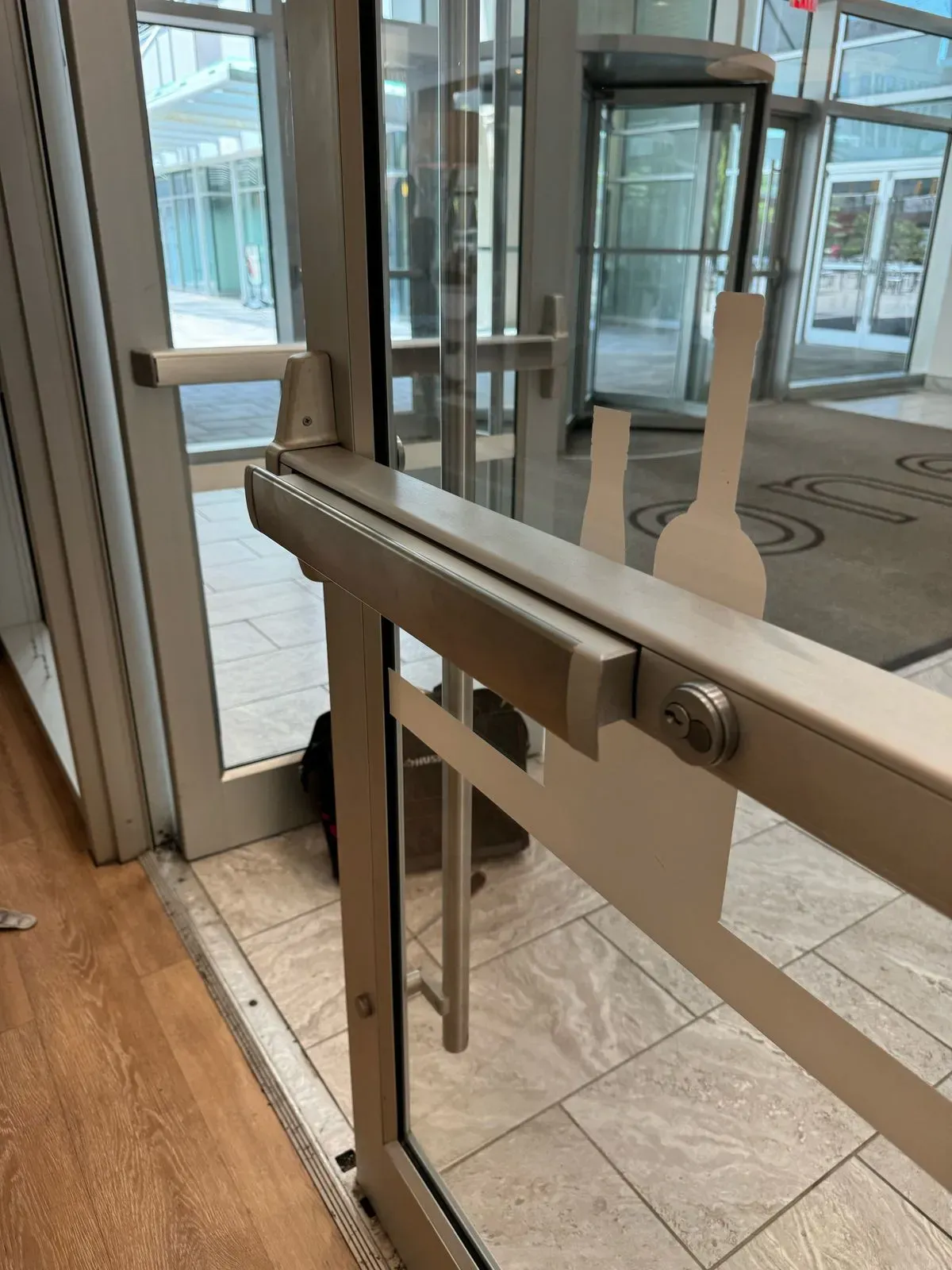
Storefront doors add a line, because aluminum-frame doors take mortise cylinders and narrow-stile hardware that standard residential parts do not fit. The commercial locksmith service covers storefront, office and shared-door hardware, and a quote that names the door type is more reliable than one that does not.
Rekey the person's keys, or restructure the system
When one employee leaves, there are two options and the choice is a cost one.
Rekeying the doors that person could open is the fast answer. Every key they held stops working, and everyone else gets a new key. It is the right call for a small office with a handful of doors.
Restructuring is the better answer when the same problem will keep happening. A master-key system gives each person a key that opens only their doors, and a single master key above them for management. Adding or removing a person then means changing one key, not rekeying a floor. The setup costs more once and saves on every departure afterward, the logic covered in master key systems for NYC buildings.
What not to change
Exit hardware on a commercial door is not a lock you can swap for a better one. Panic bars and other exit devices exist so people can leave without a key, and a replacement that requires a key to get out is a fire-safety violation, not an upgrade.
Locks on a door that serves as an exit have to keep working from the inside without special knowledge. The principle behind that rule is set out in FDNY door lock requirements, including the commercial territory it covers. A technician should tell you which doors on your list are exits before quoting any of them.
Leases and keys
Many commercial leases say who must hold keys to the premises, and some require the landlord to keep a copy. A lock change is allowed in most cases, but the lease can require notice or a duplicate to the landlord, so read it before you change anything.
If your building controls access through a shared system, the front door and common areas are the landlord's, not yours, and a lock change there is a request, not a project. For the building's own side of this, see access control systems for NYC buildings.
How to keep the cost down
Four moves save money. Audit the keys first, writing down who holds each one and what it opens, because a quote based on a real count is a firm quote. Book the visit in business hours when nothing is urgent, since the after-hours service calls are the biggest avoidable charge. Combine jobs: if you are rekeying anyway, cut spares and fix the sticking back-door lock in the same visit. And write down a key policy so the next departure does not cost the same as this one.
When a lockout is the reason you are calling, the process is different and is covered in commercial office lockouts in NYC. A commercial locksmith in Manhattan can quote the audit and the work together.
A worked example: a 12-person office
Take an office with six keyed openings: the entrance, a back door, a supply closet, a server room and two private offices. Rekeying six standard doors at $85 to $150 each runs roughly $510 to $900 in business hours. This is an illustration of how the arithmetic runs, not a quote, and the real number depends on cylinder brands, door types and key counts.
If the same office restructures into a master-key system, the cost is quoted on site, since it depends on how many levels of access you want. The trade is a higher cost once for lower cost on every departure afterward.
A sequence for the day someone leaves
Collect the keys and any access cards the same day, and write down what each one opened. List the doors the person could open and decide which of them carry anything you cannot afford to lose: the server room, the stockroom, the cash office. Rekey those first, and schedule the rest in business hours at the $65 service call.
Log the new keys by name and date, and change any alarm codes the person knew, which is not lock work but belongs in the same hour. A written sequence turns a stressful departure into a routine one, and it is the document a new manager will actually use.
When to move from keys to access control
If your office or building changes staff often, rekeying becomes a recurring cost. Electronic access control lets you remove one person's credential instantly without touching a cylinder, and it keeps a record of who opened which door and when. It costs more to install than a rekey and less over years of turnover.
It is not for every business. A small office with a stable team is better served by rekeying and a key log. A larger one, or one with shared spaces, is where the access control service earns its price, and the post covers the options for buildings.
Questions to ask before the work starts
Ask whether the technician is licensed and insured, and whether the quote names every opening and every cylinder. Ask which doors on your list are exits, and confirm that the exit hardware on them will be left alone. Ask how many keys come with each cylinder and who receives them, since handing the new keys to the wrong person undoes the point of the job.
Ask what happens if a cylinder turns out to be worn: whether the technician stops and calls you or replaces it and bills the difference. And ask for the whole job in writing, with the service call as its own line. A business that has the audit done, the estimate in writing and the visit booked in business hours has controlled most of what a lock change costs.
Frequently Asked Questions
How much does a commercial lock change cost in NYC? Rekeying a standard door starts at $85 and typically runs $85 to $150, and lock installation or repair is $125 to $450 per opening. A master-key plan is quoted on site because it depends on how many doors and how many levels of access you need.
Should I rekey or replace the locks when an employee leaves? Rekey when the hardware is sound, since it ends the old keys at the lowest cost. Replace only worn or damaged hardware.
How much does it cost to rekey a commercial lock? From $85 per door for standard locks, typically $85 to $150. High-security cylinders are priced separately.
Can I change the locks on a leased commercial space? Usually, but check the lease. Some require notice or a duplicate key for the landlord, and shared or common-area locks belong to the building.
Do I need to change panic bars when I rekey? No. A rekey changes the keyed cylinder, not the exit device. A panic bar should always open from the inside without a key.
Need Expert Help?
If you have questions about any of the security solutions discussed in this article, our team is ready to provide expert guidance.
Call us at (844) 912-1908 for a free consultation or to schedule a service.