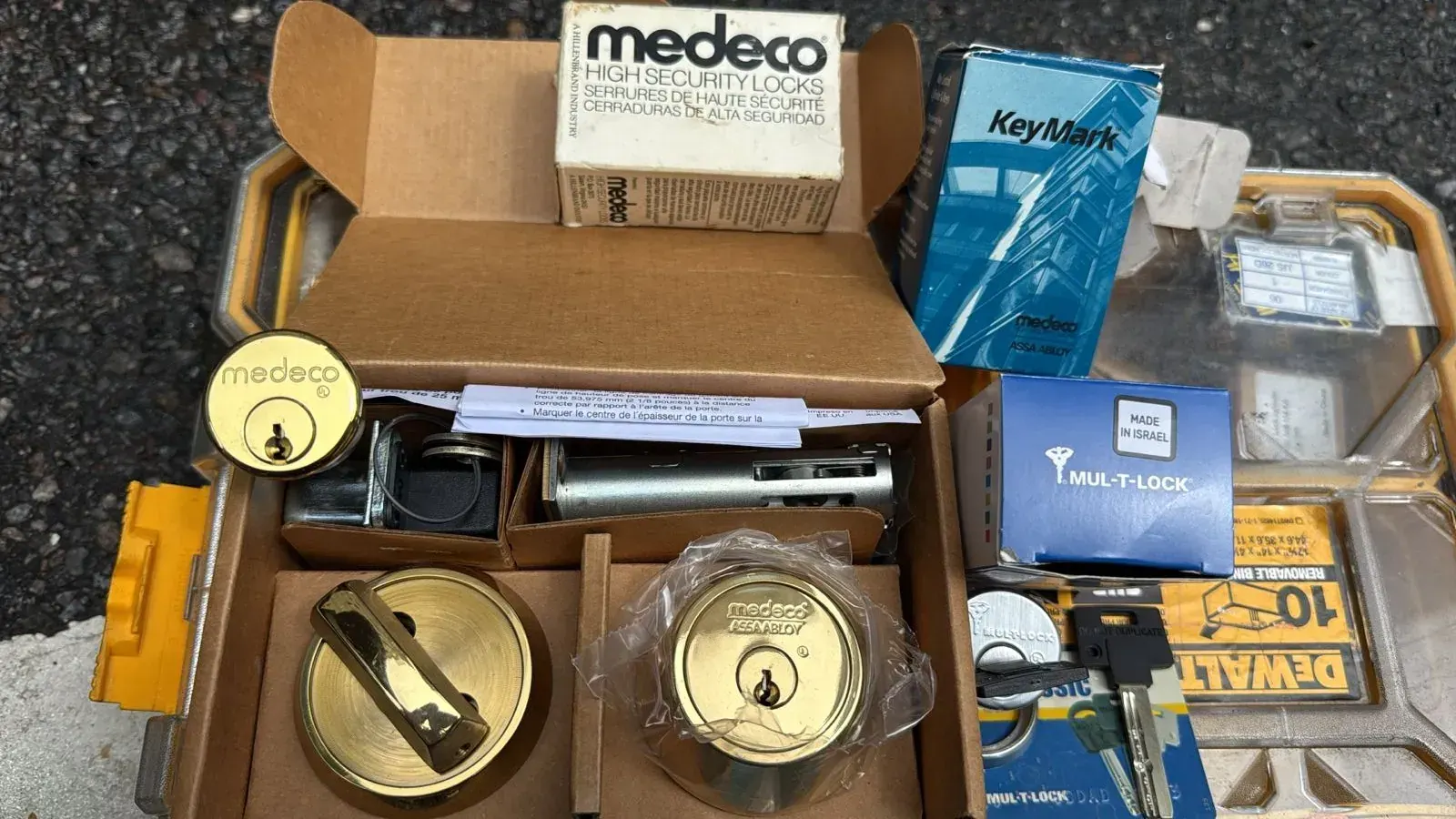
Your NYC Building’s Keys Can Be Copied at Any Hardware Store
They can, and no New York law stops it. Nothing in the state or city code prohibits duplicating a key stamped “Do Not Duplicate,” so the only real barrier between your building’s key and a three-dollar copy is whether the blank it was cut on is patented and controlled at the point of supply.
The stamp is a request. A patented keyway is a supply-chain fact. Here is the difference, and what closing it costs.
“Do Not Duplicate” is a stamp, not a law
The Associated Locksmiths of America is blunt about it: orders for keys stamped “Do Not Duplicate” or similar wording are handled the same way as any unrestricted key, the marking is not effective security, and its use is deceptive because it provides a false sense of security. ALOA points those customers toward a patented key system instead.
A few states do legislate the stamp. California Business and Professions Code §6980.54 bars a licensed locksmith from duplicating a key marked “Do Not Duplicate” or “Unlawful To Duplicate,” but only when the key also carries the originator’s company name and telephone number.
New York has no equivalent, at state or city level. The words on the key carry no legal weight here. A hardware store, a supermarket kiosk or a licensed locksmith can all cut an ordinary key carrying that stamp without breaking a rule. A master key is the exception, and the next section is why.
Who can legally cut a copy of your key in New York
New York City regulates locksmiths tightly, but it regulates opening locks, not copying keys. The rules sit in Administrative Code Title 20, Subchapter 15, sections 20-298 through 20-307. Section 20-299 makes it unlawful to work as a locksmith without a DCWP license, and §20-301 makes it unlawful for anyone other than a licensed locksmith to open a lock whose key has been lost, alter a lock’s mechanical adjustment, or make an original key. Cutting a duplicate from a key you already hold is not named on that list, which is why the hardware-store kiosk operates openly.
One duplication control does exist in the city code, and it is narrow. Section 20-303 requires keys made by a licensed locksmith to carry the locksmith’s identification, requires master keys to carry the word “master” and to be made only by a licensed locksmith, and allows duplicates of them only upon the signed order of the owner of the locks or an authorized agent. Section 20-301 adds a records duty: the locksmith logs the name and address of everyone ordering master keys, keys by number, or an opening, with the date and time.
A NYC building master key therefore has a statutory paper trail. The tenant key, the super’s working key and the contractor’s copy do not. You can check any locksmith’s license standing in the free DCWP portal at a866-dcwpbp.nyc.gov/search.
What a patented keyway actually restricts
A restricted keyway moves the control off the key face and into the metal. The blank itself, its profile and the moving element inside it, is covered by a live utility patent, so nobody outside the licensing chain can lawfully make it, and the maker releases blanks only through a contracted channel: in some systems to dealers under contract, in others straight to the named end user.
Read the family name, not the brand. Schlage’s Everest 29 S keyways are the trap, patented but sold with no ordering formalities, while only the R and T families are controlled. Patent terms also end. Ask the dealer which family your blank belongs to and how long it stays protected: those two answers decide whether the control is live or nominal.
| System | What has to happen before a copy exists |
|---|---|
| Medeco 4 (M4) | Authorized dealer cuts it against the card on file |
| Abloy Protec2 | Duplication card shown to an authorized dealer |
| Schlage Everest 29, restricted R and T families | Blanks and cut keys drop-shipped to the end user, not dealer stock |
| Mul-T-Lock MT5+ | Magnetic order card read by the dealer’s machine |
| Schlage Primus XP | Dealer-controlled blank plus a factory-milled sidebar |
A lapsed patent does not cancel the dealer agreement. Dealers stay contractually barred from cutting these keys without authorisation and the signature card still governs, so when a term ends the contract does the work the blank used to. That is a weaker form of the same control, not its absence.
The signature card: how key control works day to day
All of these run the same procedure with different hardware behind it. You sign a card held by the dealer, naming who may order keys. A person on that card presents identification, the dealer matches the signature, cuts the key on a controlled blank, and logs it.
The result is an answerable question: how many keys exist, and who signed for each. If you already own a restricted system and just need another copy, getting a legitimate copy of a restricted key is a different job from the upgrade decision here.
Three moments that should trigger an upgrade
After a break-in or a lost set
If a key went missing rather than a door being forced, putting more of the same blank back rebuilds the same problem. This is where the upgrade costs least, because you are already paying for cylinder work: moving to a restricted keyway on the same visit closes the question instead of deferring it.
When a super, porter or contractor leaves
Building staff accumulate keys over years and nobody logs them. A departing super hands back a ring, and nobody can say how many copies were cut meanwhile. A restricted keyway answers that from the dealer record.
Renovation handover
A gut renovation puts a working key in the hands of a general contractor, an electrician, a plumber and whoever they subcontracted. The right sequence, covered in full in our guide to key control during a renovation, is a temporary cylinder during the work and a restricted cylinder at handover, so the key that finishes the job is not the one that stays on the door.
Fitting a restricted cylinder to a NYC door
Most of this work needs no door modification. A pre-war mortise case takes a threaded mortise cylinder and a Segal-style vertical deadbolt takes a rim cylinder, both through the prep already in the door. A bored deadbolt usually accepts a replacement cylinder or a whole high-security deadbolt in the existing hole. One restricted blank can carry every lock in the apartment, so keying them alike gets easier, not harder.
Renters hit two limits here. Multiple Dwelling Law §51-c gives most tenants of a multiple dwelling the right to install a lock on their own entrance door, separate and apart from any lock the owner installed. That is a right to add a lock, not to swap the owner’s cylinder for a restricted one, which is usually the thing a renter actually wants. The second limit sits in the same sentence: a duplicate key goes to the landlord or the agent on request, so the control you just bought leaves your hands the first time it is asked for.
Specify the standards by name: ANSI/BHMA A156.30 for high-security cylinders, which grades key control, destructive attack and surreptitious entry separately as level A, B or C; A156.36 for the auxiliary deadbolt; A156.5 for the cylinder; plus a UL 437 listing, the independent test for picking, drilling and forcing.
What it costs, and what it does not buy
| Job | Typical NYC range | What moves the number |
|---|---|---|
| Rekey an existing standard door | From $85 per door | Cylinder count, keyed alike or not |
| Apartment door, both cylinders rekeyed | $85 to $150 | Knob plus deadbolt |
| High-security cylinder supplied and installed | $225 to $500 per cylinder | Platform, door prep, finish, cylinder count |
| Building-wide restricted system | Quoted per door | Door count, master levels |
The per-building number lands better than people expect: the signature card is set up once and covers every door on the system, so a six-unit walk-up doing lobby, basement, roof and six apartment doors pays per cylinder, not per setup. Our own high-security lock installation in NYC runs $225 to $500 per cylinder installed and is quoted on site: a 1928 Astoria mortise case and a 2019 condo door are different jobs at the same address.
Now the limit. A restricted keyway controls who holds a working key and does nothing about a door that gets forced, which is the failure we are called out to more often. UL 437 tests the cylinder, not the frame. That half of the door is bought separately, as a Grade 1 deadbolt on a properly anchored strike. A restricted keyway does nothing about a propped lobby door either, which is where credential control for a whole building beats cutting more keys.
Key control is a bookkeeping fix for a bookkeeping problem: you do not know who has a key. Buy it for that, pair it with hardware that resists force.
Frequently Asked Questions
Is it illegal to copy a key stamped Do Not Duplicate in New York?
No. No New York State or New York City statute prohibits duplicating a key stamped “Do Not Duplicate,” and the marking is a request from whoever ordered the key with no enforcement behind it. The only duplication rule in the NYC locksmith code, §20-303, covers master keys, which may be copied only on the signed order of the owner of the locks or an authorized agent.
What is a restricted keyway and how does it stop copies?
A restricted keyway uses a blank whose shape and internal moving parts are covered by a live utility patent, and the maker releases it only through a contracted channel. A hardware store cannot copy the key because it has no blank to cut it onto. The copy comes from an authorized dealer, who checks your identity against a signature card first.
How much do high-security locks cost per door in NYC?
High-security cylinders run $225 to $500 per cylinder supplied and installed in New York City, so a door carrying a knob and a deadbolt is two cylinders. Rekeying ordinary hardware you own runs from $85 per door. The spread depends on the platform, the finish and the door prep. Building-wide systems are quoted per door, with one signature card covering all of them.
Can a restricted cylinder go into an old NYC mortise lock?
Usually, yes, with no door modification. A pre-war mortise case takes a threaded mortise cylinder, so the restricted cylinder screws into the lock body already in the door and the original case stays put. A Segal-style vertical deadbolt takes a rim cylinder through the same hole. The cylinder is the part that carries the key control, not the lock case.
Should a co-op rekey the whole building when a super leaves?
If the building runs ordinary keyways, yes, because nobody can say how many copies were cut during that super’s tenure. A building on a patented system with an active signature card checks the dealer record instead and often only needs the master level changed. Key control turns a full rekey into a records lookup.
Do high-security locks stop someone kicking the door in?
No. A patented cylinder controls key duplication and resists picking and drilling, and a UL 437 listing tests picking, impressioning, drilling, prying, pulling and sawing on the cylinder. None of it addresses a frame that splits when the door is kicked. Pair the cylinder with a Grade 1 deadbolt, a reinforced strike plate and 3-inch screws into the framing behind the jamb.
Need Expert Help?
If you have questions about any of the security solutions discussed in this article, our team is ready to provide expert guidance.
Call us at (844) 912-1908 for a free consultation or to schedule a service.