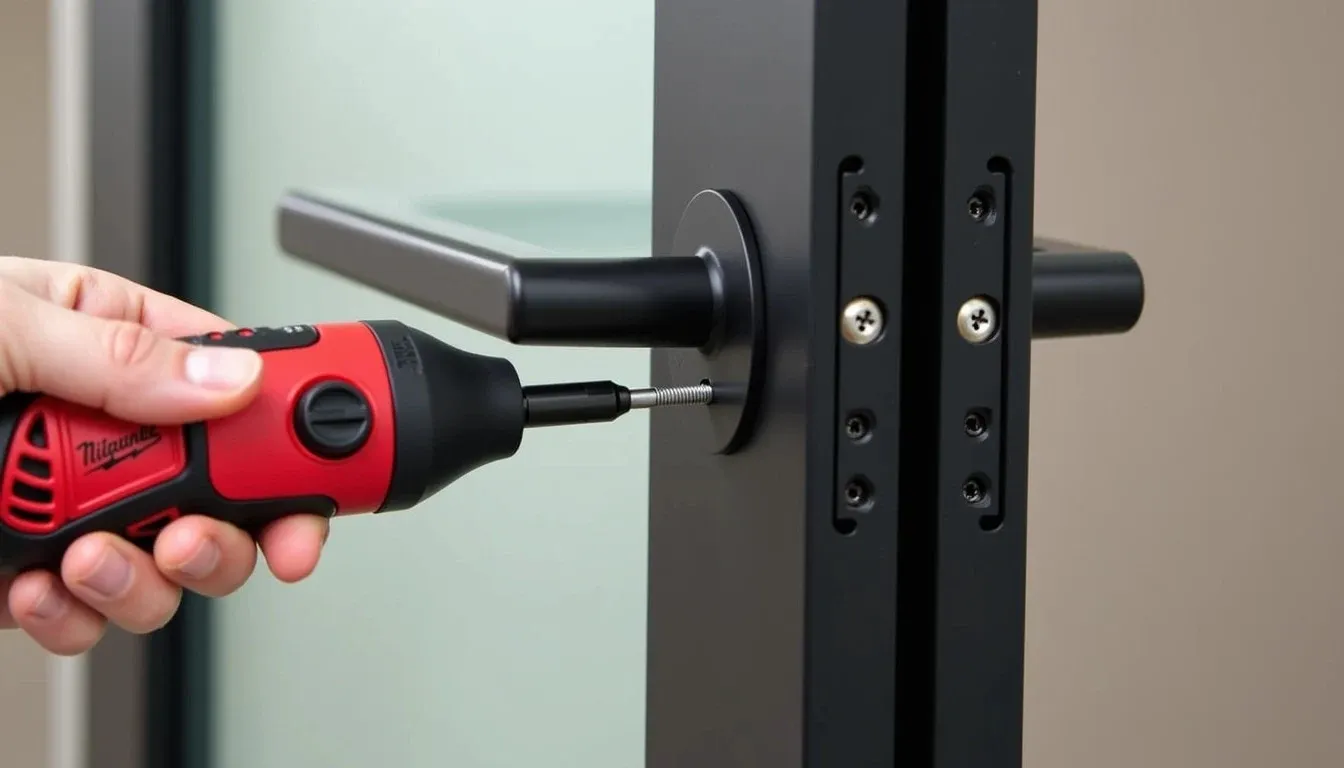
Deadbolt Installation in NYC and What the Code Requires
New York City requires a heavy duty latch set and a heavy duty dead bolt on the entry door of every apartment in a class A multiple dwelling, keyed from the outside and operated by a thumb-turn inside. Installed, that is $125 to $250 for a Grade 2 deadbolt in a door already bored, and $225 to $500 for a Grade 1 or restricted-keyway cylinder.
That sentence is Administrative Code §27-2043, and it is the entire legal specification: grade, bolt throw, keyway and brand decide how long the bolt holds, not whether the door passes. Cutting a new bore adds labor, and on a labelled fire-rated door it may not be legal at all.
What NYC law actually requires on an apartment entry door
Four provisions of the Housing Maintenance Code govern the hardware on a dwelling unit entrance door, and all put the duty on the owner, not the tenant.
| Section | What it requires |
|---|---|
| §27-2043(a) | A key lock and at least one key in each dwelling unit entrance door. In a class A multiple dwelling, a heavy duty latch set plus a heavy duty dead bolt, key outside, thumb-turn inside. |
| §27-2043(b) | In a class A multiple dwelling, a chain door guard permitting partial opening of the door. |
| §27-2041 | A peephole, provided and maintained, positioned to view anyone immediately outside. Hotels, dormitories, and one- and two-family homes where the door is already visible from inside excepted. |
| §27-2041.1 | Self-closing doors required under Administrative Code §28-315.10 kept in good repair. HPD writes it as a class C immediately hazardous violation, 14 days to correct against 24 hours for most class C conditions. |
Read the first row again. The code names no manufacturer, no ANSI grade and no bolt length. “Heavy duty” is the only qualifier and is nowhere defined by number, which is why two apartments on one floor can both be compliant and hold up very differently under a pry bar. The fire-safety half sits in the full NYC door-hardware compliance rules.
Why a deadbolt keyed on both sides is not permitted here
The thumb-turn in §27-2043 is not decoration. HPD states the position plainly on its own fire safety page: it is illegal to install key-locked window gates on fire escapes and double-cylinder locks on apartment doors, which can trap residents inside in the event of a fire.
The Building Code reaches the same result from the other direction. Section 1010.1.9 requires egress doors, except where that section itself permits otherwise, to be readily openable from the egress side without a key, special knowledge or effort. A deadbolt needing a key on the inside fails that test in the dark, the only condition that matters.
Grade 1 against Grade 2, and what the standard does not test
Deadbolts are graded under ANSI/BHMA A156.36, Auxiliary Locks, formerly part of A156.5. It sets dimensional criteria and five classes of test: operational, cycle, strength, security and finish. A Grade 1 deadlock passes 250,000 cycles, and the security battery includes a 1,350 pound force applied to the door against the thrown bolt.
What the grade does not measure is key control. It describes how the bolt resists a body, a pry bar and a drill, not how many copies of your key exist. That is a property of the keyway. The Kwikset 980 is Grade 1, rekeys itself in seconds with the SmartKey tool, and sits on the KW1 keyway every hardware counter in the five boroughs cuts on sight. The Medeco Maxum is Grade 1 too, certified under the predecessor standard A156.5, UL 437 listed for drill and pick resistance, and it runs a patented keyway whose blanks are not sold over a counter.
Both are correctly rated; they answer different questions. If yours is who still holds a working key, the answer is a restricted-keyway cylinder, not a stronger bolt.
The one-inch throw, and the strike that decides whether it matters
Every deadbolt worth fitting on a NYC apartment door throws an inch. The Schlage B60N is Grade 1 with a 1 inch bolt, an anti-drill plate and a hardened roller pin. The B560 is the Grade 2 sibling, certified to A156.36, same throw. The Mul-T-Lock Hercular throws its inch on a 90 degree key turn and interlocks two hardened ball bearings into the strike as it goes.
That inch is spent entirely in the door frame, which is where most NYC installs fail. A bolt landing in a strike held by two three-quarter-inch screws into pine trim transfers the whole attack to the trim. The B60N ships with an integrated strike reinforcer and 3 inch screws; the B560 adds a metal dust box behind the strike. Three-inch screws driven through the strike into the framing behind the jamb cost nothing and change the failure mode of the door. Between a Grade 1 lock on a weak frame and a Grade 2 on an anchored strike, take the second: the frame is what a pry bar attacks, and the strike is the only part of it you can buy.
Your door decides the deadbolt, not the catalog
Four door types cover most of the residential stock here, each setting a different job.
| Door | What fits | The visit |
|---|---|---|
| Already bored: 2-1/8 inch cross bore, 1 inch edge bore, 2-3/8 or 2-3/4 backset | Any standard deadbolt in the right backset | Straight swap, 30 to 45 minutes |
| Solid wood, never bored | Same hardware, but the door has to be cut | Boring and chiseling on site |
| Pre-war mortise case | A replacement mortise cylinder, not a new lock | Cylinder swap inside the existing case |
| Segal-style surface rim lock | A replacement rim lock or rim cylinder | Surface work, no boring |
Door thickness ends more installs than anything else. The Schlage B60N fits doors from 1-3/8 to 1-7/8 inches; the Medeco Maxum is built for 1-3/8 to 2-1/2, and a heavy pre-war door often measures past the first range. The mortise case surprises people most: nothing needs boring and usually nothing needs replacing, because the deadbolt already sits in the case and only the cylinder carries the keying. Pre-war mortise doors are a different job.
Fire-rated doors: what cannot be drilled on site
Fire ratings are common on NYC apartment entries and on every stair and corridor door in the building. The tell is a small metal label on the hinge edge, and once it is there NFPA 80 sets what may be cut.
The standard separates two things. Job site preparations, section 5.1.5.2, are what is allowed in the field: holes for surface-applied hardware, function holes for mortise locks and labelled viewers, undercutting up to three-quarters of an inch on wood and composite doors, and protection plates. Field modifications, section 5.1.5.1, are everything else, cylindrical lock preparations and mortise pockets included, and they need the manufacturer to obtain written permission from the listing laboratory first. Cut without it and the assembly may have to be relabelled.
The work splits cleanly. Swapping a cylinder or deadbolt into an existing prep is a same-visit job on a fire door. Adding a second deadbolt where no hole exists is not, and on a door that also has to self-close under §27-2041.1, taking the assembly out of its listing is not a quiet problem.
What it costs in NYC, and who has to authorize it
The spread inside each band is door condition, backset, thickness and frame movement.
| Job | Price |
|---|---|
| Rekey an existing deadbolt | From $85 per door |
| Rekey both cylinders on a typical apartment door | $85 to $150 |
| Grade 2 deadbolt supplied and installed | $125 to $250 |
| Grade 1 or restricted-keyway cylinder | $225 to $500 per door |
| New bore on an unprepped door | Added labor, quoted on site |
Who signs off depends on the work. Replacing hardware the owner must maintain under §27-2043 is the owner's job and the owner's money. Adding a second deadbolt of your own is a different right, and Multiple Dwelling Law §51-c sizes it: not more than three inches in circumference, measured around the lock body. An ordinary bored deadbolt sits comfortably inside that, a large surface-mounted rim case often does not, and the condition attached is a duplicate key to the landlord on request.
We are a mobile service dispatched from Astoria and Long Island City, and our average response across the five boroughs is 25 minutes, longer overnight or across a bridge. Most of it is deadbolt installation and repair across NYC, booked like any other residential lock work, and where the hardware is sound the better answer is often to rekey it to the key you already carry.
Frequently Asked Questions
What kind of deadbolt does NYC law require on an apartment door?
Administrative Code §27-2043 requires a heavy duty latch set and a heavy duty dead bolt on a class A multiple dwelling unit entrance door, keyed outside and turned by a thumb-turn inside, plus a chain door guard under subsection (b). It names no brand, no ANSI grade and no bolt length, so any single-cylinder deadbolt with a thumb-turn meets the letter of it. Grade decides how long it holds, not whether it is legal.
Can I install a deadbolt that needs a key on both sides?
No. HPD states on its fire safety page that double-cylinder locks on apartment doors are illegal because they can trap residents inside during a fire, and Building Code §1010.1.9 requires egress doors to open from the inside without a key. Section 27-2043 independently requires the thumb-turn, so the hardware the owner is obliged to provide cannot be a key-both-sides lock.
How much does deadbolt installation cost in NYC?
A Grade 2 deadbolt supplied and installed into a door already bored runs $125 to $250, and a Grade 1 or restricted-keyway cylinder $225 to $500 per door. Rekeying hardware you already own runs $85 to $150 for a typical apartment door. Boring an unprepped door adds labor, quoted once the door is seen.
Can you put a deadbolt on a hollow metal apartment door?
Yes, and it is the easiest case, because most hollow metal apartment doors already carry the standard bored prep: a 2-1/8 inch cross bore, a 1 inch edge bore and a 2-3/8 or 2-3/4 inch backset. A deadbolt drops in once backset and thickness match. The exception is a labelled fire door with no existing hole, where NFPA 80 bars a new cylindrical lock preparation in the field without the listing laboratory's approval.
Do I need my landlord's permission to add a deadbolt in NYC?
Multiple Dwelling Law §51-c gives a tenant of a multiple dwelling the right to install their own lock in their unit's entrance door, separate from the owner's, provided it is not more than three inches in circumference and a duplicate key goes to the landlord on request. It covers adding a lock, not removing the owner's, and it does not reach public housing, hotels or dormitories. Co-ops and condos run on board rules and often an alteration agreement, so ask there first.
Is a Grade 1 deadbolt worth it over a Grade 2?
It depends which failure you are buying against. Grade 1 passes 250,000 cycles and a 1,350 pound force against the thrown bolt, so it earns the difference on a ground-floor door, a door onto a public hallway, or one already attacked once. If the worry is instead that too many people hold a copy of the key, grade is not the fix: a restricted keyway on a Grade 2 body beats a Grade 1 on a keyway sold everywhere.
Need Expert Help?
If you have questions about any of the security solutions discussed in this article, our team is ready to provide expert guidance.
Call us at (844) 912-1908 for a free consultation or to schedule a service.