Most NYC Package Theft Happens Inside Your Building
Roughly three out of four reported package thefts in New York City happen inside the building, not on the stoop. That single fact should change what you spend money on, because a camera pointed at your front steps does nothing about a thief who walked through the lobby door behind a delivery driver.
That is the short version. The number is checkable, so here is where it comes from.
What the NYPD data actually says
The NYPD records package theft as its own category, and it splits that category by where the package was taken from. Pulling the complaint data for the first half of 2026, from 1 January to 30 June, gives 8,546 reported package thefts citywide, in four labels:
| NYPD classification | Complaints |
|---|---|
| LARCENY, PETIT FROM BUILDING, UNATTENDED, PACKAGE THEFT INSIDE | 5,957 |
| LARCENY, PETIT FROM BUILDING, UNATTENDED, PACKAGE THEFT OUTSIDE | 2,175 |
| LARCENY, GRAND FROM RESIDENCE/BUILDING, UNATTENDED, PACKAGE THEFT INSIDE | 311 |
| LARCENY, GRAND FROM RESIDENCE/BUILDING, UNATTENDED, PACKAGE THEFT OUTSIDE | 103 |
Add the two inside rows and you get 6,268. Add the two outside rows and you get 2,278. Inside the building accounts for 73% of reported package theft.
The grand and petit split is about value, not location. Under Penal Law § 155.30, a person commits grand larceny in the fourth degree when “the value of the property exceeds one thousand dollars.” Everything below that line is petit larceny, which is why the petit rows are so much larger. Most stolen packages are not laptops.
You can pull this yourself from the NYPD complaint dataset on NYC Open Data. Two cautions if you do. The dataset contains obvious data-entry errors in the date field, including complaints stamped with years in the eleventh century, so bound your query by date rather than trusting the minimum. And these are reported complaints, not total thefts. Nobody files a police report over a $14 phone case, so the real inside-versus-outside ratio is anyone’s guess. What the data supports is the direction, and the direction is not subtle.
The borough numbers, and how not to read them
| Borough | Complaints, Jan–Jun 2026 |
|---|---|
| Brooklyn | 2,621 |
| Queens | 1,824 |
| Manhattan | 1,785 |
| Bronx | 1,569 |
| Staten Island | 194 |
| Unspecified | 553 |
Do not read that as a risk ranking. These are raw counts, and they track population and delivery volume more than anything else. Brooklyn leading and Staten Island trailing is roughly what you would predict from how many packages get delivered in each place. The table is useful for showing that this is a citywide problem in every borough with apartment buildings, and not much else.
Why “inside” changes the fix
If most theft happened on the doorstep, the answer would be cameras and delivery lockers, and the industry sells plenty of both.
But the thief who takes a package from a lobby got into the lobby. In a NYC building that almost always happens one of four ways:
- Tailgating. Someone follows a resident or a delivery driver through the door. No hardware defeats a door a person is holding open.
- The door was not locked. It closed but never latched, so it looked shut and pushed open.
- The door was propped. Tape over the latch, a wedge, a brick, a magnetic hold-open left engaged after a move-in.
- A delivery code or building fob is circulating. This is more common than boards like to think.
Only the first and last are behavioural. The middle two are the door, and they are the ones a locksmith can actually fix. That matters because they are also the cheapest to fix, and they are the ones nobody inspects until something goes wrong.
Why NYC lobby doors stop latching
This is the part that is genuinely a trade question rather than a security-industry one. Vestibule and lobby doors in this city get used hundreds of times a day, and they fail in predictable ways.
The door closer is out of adjustment. A closer has separate valves for the sweep and the final latching inch. When the latch speed drifts too slow, the door drifts shut and rests against the strike without the latch ever throwing. It looks closed from ten feet away. It opens with a push. This is the single most common cause, and it is an adjustment, not a replacement.
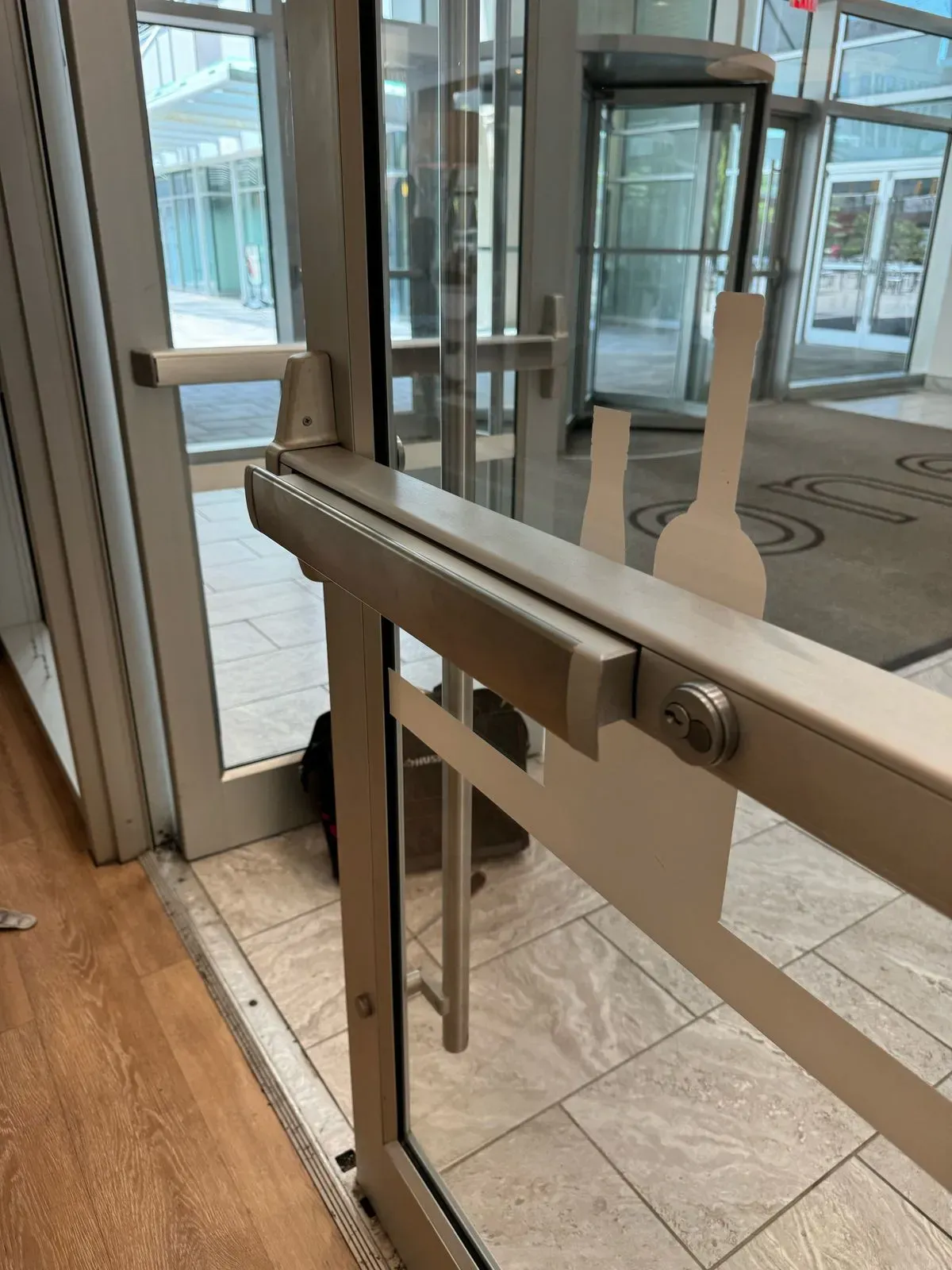
The deadlatch plunger is worn or misaligned. This is the small secondary plunger next to the main latch bolt on a lobby door. Its whole job is to sit against the strike plate and stop the main latch from being pushed back with a card or a shim. If the plunger is worn, or if the door has dropped so the plunger falls into the strike opening instead of resting on the plate, the latch can be slipped in seconds by anyone who has seen it done once. A door in this condition is functionally unlocked and looks perfectly normal.
The strike is worn or the door has dropped. Pre-war buildings move, hinges wear, and heavy glass-and-metal vestibule doors sag. The latch then hits the strike lip rather than entering the pocket.
The gasket or sweep has swollen. Weatherstripping compresses over years, and in humid months a swollen gasket can hold the door just off the strike.
Someone defeated it on purpose. Tape across the latch is the classic. Check for it. It is put there by residents who are tired of buzzing people in, and it stays for weeks.
The useful thing about that list is that a broken lobby door is usually not a broken lock. It is an adjustment, a strike, a plunger, or a hinge, and none of those need an access control project to solve.
What it costs to fix
| Job | NYC cost |
|---|---|
| Door hardware repair: closer adjustment, strike, latch alignment | $150 – $400 |
| Lock installation or replacement, per opening | $125 – $450 |
| Access control system, per door | from $500 |
The order matters. Fixing the door so it latches every time is a few hundred dollars. Putting an access control system on a door that does not reliably latch buys you a credential reader on a door that still pushes open, which is an expensive way to feel better.
We handle the repair side through lock installation and repair, and the systems side through access control systems for NYC buildings once the door itself is sound.
The five-minute test anyone can run
You do not need a locksmith to find out whether your building has this problem.
- Let the door close on its own. Do not push it, do not pull it. Walk away and watch it close from the outside.
- Push on it. If it opens, the latch is not throwing. That is your answer.
- Look at the latch edge. Find the small plunger beside the main latch bolt. With the door shut, it should be pressed in against the strike plate, not sitting in the hole.
- Check for tape. On the latch, on the strike, anywhere someone could have defeated it.
- Time the closer. If the last few inches are slow and gentle, the latch valve needs adjusting.
Run it twice, once in the morning and once on a cold evening. Doors behave differently as the building expands and contracts, and a door that latches in July may not in January.
If you are a tenant and the door is broken
Report it in writing to the landlord or managing agent, and describe it precisely. “The lobby door does not latch and pushes open” gets a different response from “the front door is broken.” A front entrance door that fails to lock in a multiple dwelling is a repair obligation, not a discretionary upgrade, and the same rules that cover your apartment door reach the building entrance. We set out how that obligation works, and how to escalate it, in my NYC apartment door will not lock.
Keep the written record. If the door has been reported repeatedly and stays broken, that record is what makes the difference later.
Frequently Asked Questions
Where does most package theft in NYC actually happen?
Inside the building. In NYPD complaint data for January to June 2026, 6,268 of 8,546 reported package thefts were classified as package theft inside, against 2,278 outside. That is 73% inside.
Does a doorbell camera help?
Against doorstep theft, somewhat. Against the 73% that happens inside the lobby, not much, because the camera is pointed at the wrong side of the door. If you are spending money on this problem, spend it first on making the entrance door latch reliably.
Why does our lobby door look closed but push open?
Almost always the door closer’s latch-speed valve has drifted, so the door drifts shut without the latch throwing. It can also be a worn strike, a dropped door, or a swollen gasket holding it a fraction off the strike. All of those are repairs rather than replacements, typically $150 to $400.
What is a deadlatch and why does it matter?
It is the small plunger next to the main latch bolt. When the door is shut, it rests against the strike plate and stops the main latch being pushed back with a card. If it is worn, or if the door has sagged so the plunger drops into the strike opening, the door can be opened in seconds without any damage. It is the most commonly overlooked failure on a NYC lobby door.
Should our building install access control?
Fix the door first. A credential reader on a door that does not latch reliably does not stop anyone. Once the door closes and latches every time, access control is worth considering, from around $500 per door, and it also solves the circulating-fob problem because credentials can be deactivated individually.
Can the building be held responsible for stolen packages?
That depends on the lease, the building’s own rules, and whether staff accepted the package. It is a separate question from whether the entrance door meets the owner’s repair obligations, which it must regardless of who is liable for the contents.
Need Expert Help?
If you have questions about any of the security solutions discussed in this article, our team is ready to provide expert guidance.
Call us at (844) 912-1908 for a free consultation or to schedule a service.