Do NYC Landlords Have to Change Locks Between Tenants?
No. There is no New York State law and no New York City law that requires a landlord to change or rekey the locks between tenants. HPD will not write you a violation for handing a new tenant the same key the last one used. If you are looking for the rule, there isn't one.
That is the short version, and it is where every other page on this question stops. The useful part starts after it. The law does require you to provide a working lock and a key. Your incoming tenant is allowed to install their own lock whether you like it or not, and you cannot charge them for it. And "no statute requires it" is not the same as "nothing can go wrong," which is the part that costs money.
What NYC law actually requires
The operative section is NYC Administrative Code § 27-2043, part of the Housing Maintenance Code that HPD summarizes in its ABCs of Housing. It reads:
a. The owner of a dwelling shall provide a key lock in the entrance door to each dwelling unit and at least one key. In a class A multiple dwelling such door shall be equipped with a heavy duty latch set and a heavy duty dead bolt operable by a key from the outside and a thumb-turn from the inside. b. Each dwelling unit entrance door in a class A multiple dwelling shall also be equipped with a chain door guard so as to permit partial opening of the door.
Read it twice, because what is missing matters more than what is there. The section governs the hardware on the door: a key lock, at least one key, and in a Class A multiple dwelling a heavy-duty latch set, a heavy-duty deadbolt, and a chain guard. It says nothing about how many keys exist in the world, nothing about who held them last year, and nothing about rekeying at turnover.
So the compliance floor is low. The lock has to be there and it has to work. A missing, broken, or non-conforming lock is what HPD code enforcement actually writes up. An unrekeyed one is not.
The gap that leaves open
Count the keys that existed for a typical NYC unit at the end of a two-year tenancy. The tenant had two. Their roommate had one. The broker who ran three open houses had one, and may or may not have given it back. The tenant's partner had one, and if that relationship ended badly, nobody told you. The cleaner had one. Somebody's parent has one from a visit in 2024. A key was copied at the hardware store on the corner for $3, no ID, no record, because a standard Kwikset or Schlage blank is sold to anyone who walks in.
You are not handing the new tenant a lock. You are handing them a lock plus an unknown number of outstanding keys, and neither of you can count them.
That is the whole argument for rekeying at turnover, and it does not depend on a statute existing. It is the same reason we tell renters to change the locks before they unpack. The difference is that when the owner does it once at turnover, it costs less and it happens on schedule.
Where the liability actually sits
New York landlords do owe tenants a common-law duty. The Court of Appeals stated it in Burgos v. Aqueduct Realty Corp., 92 N.Y.2d 544 (1998): a landlord has a duty to take minimal precautions to protect tenants from foreseeable harm, including harm from foreseeable criminal conduct.
Now the honest limit, because this is where locksmith marketing usually starts lying. Burgos also holds that in a premises-security case, the causal link between the landlord's failure and the tenant's injury can be established only if the assailant gained access through a negligently maintained entrance. That framing is about intruders and building doors. No New York case squarely holds that failing to rekey a unit between tenants is negligence.
So the realistic exposure is not a bright-line rule you have broken. It is this: a prior tenant lets themselves in, and you are now the defendant explaining to a jury why you gave a new tenant a lock you knew other people could open. You will probably win. You will pay your lawyer either way, and your insurer will remember it. A $150 rekey is cheaper than the first hour of that conversation.
Your new tenant can change the lock without asking you
This surprises most small landlords. Under Multiple Dwelling Law § 51-c, a tenant in a multiple dwelling may install their own lock on the entrance door of their apartment, in addition to the lock you supplied. Three conditions come with it:
- The lock must be no more than three inches in circumference. That is circumference, not diameter, so it is a small lock: a standard rim cylinder or a slim deadbolt, not a heavy commercial unit.
- The tenant must supply you a duplicate key on request. You have to ask. They do not have to volunteer it.
- Any lease clause charging for the privilege is dead. The statute voids "the payment by such tenant of any additional rent, bonus, fee or other charge or any other thing of value for the right or privilege of installing and/or maintaining any such lock," calling it "void as against public policy and wholly unenforceable."
Three practical consequences for an owner. You cannot forbid it. You cannot bill for it. And if you did not rekey at turnover, a security-conscious tenant will simply do it themselves, at which point there is a lock on your door that you did not choose, may not be able to service, and hold a key to only if you remembered to ask. Rekeying at turnover is the cheaper way to stay in control of your own hardware. The tenant-side version of this rule is here, and it is worth reading so you know what your tenant knows.
When you absolutely must not touch the lock
Everything above assumes the unit is legally vacant. If a tenant is still in possession, changing the lock is not a turnover task. It is an illegal lockout, with criminal and civil exposure, and it does not matter how far behind on rent they are or how clearly they have moved out in your judgment. Possession ends with a court order and a marshal, not with your assessment. We wrote that up separately: locked out by your landlord in NYC.
We also decline these calls. A licensed NYC locksmith who changes a lock on an occupied unit at an owner's request is exposed alongside the owner, so if the paperwork is not in order, we will not do it.
Rekey or replace, and what each costs per unit
Rekeying keeps your existing hardware and re-pins the cylinder to a new key. Every old key stops working the moment the tech finishes. Replacing means new hardware on the door.
| Job | NYC cost | Time |
|---|---|---|
| Rekey, standard door | from $85 | under an hour |
| Typical apartment (knob and deadbolt) | $85 – $150 | about an hour |
| Grade-2 deadbolt, installed | from $150 | about an hour |
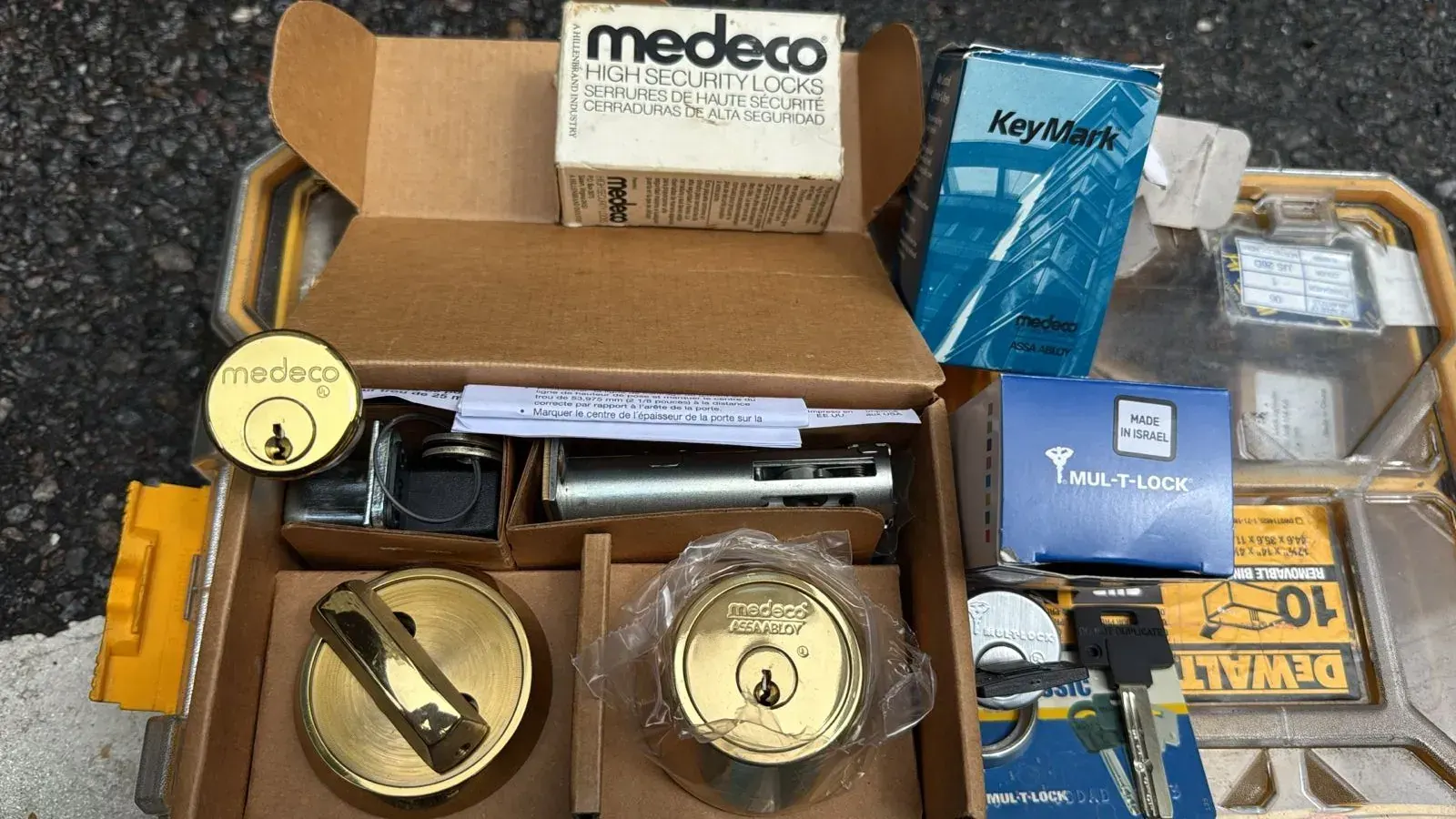
| High-security cylinder (Medeco, Mul-T-Lock, Schlage Primus) | quoted on site | about an hour |
For turnover, rekeying is almost always the right call. The hardware on the door is usually fine; the problem is the key list, and re-pinning solves exactly that. Replace when the hardware is worn, damaged, builder-grade, or when you are upgrading the unit anyway. The full comparison is in rekey or replace, and our lock change and rekeying service covers all five boroughs same-day.
One number worth sitting with: at $150 a unit, rekeying a 20-unit building at every turnover, with a 30% annual turnover rate, costs about $900 a year. That is a rounding error against one vacancy.
Doing it at building scale
If you own or manage more than a handful of units, two upgrades make turnover rekeying close to free in effort.
A master key system. Each tenant's key opens their unit only. Your master opens every unit, the compactor room, the roof door, and the basement. Rekeying one apartment at turnover does not disturb the master, so a turnover is a ten-minute cylinder swap rather than a project. It also ends the coffee-can-of-unlabelled-keys problem in the super's closet. We set these up building by building, and there is a longer walkthrough in master key systems for NYC buildings.
A restricted keyway. Medeco, Mul-T-Lock, and Schlage Primus blanks are not sold to the public. A departing tenant cannot have quietly made six copies at the hardware store, because the hardware store does not have the blank. Copies happen only on your written authorization. It costs more per cylinder up front and it removes the underlying problem instead of managing it every two years. See high-security locks for which system fits which building.
For a walk-up with a keyed-alike front door and no super on site, restricted keyways are usually the better spend. For a 40-unit elevator building with staff, a master system pays for itself in labor within a year.
A turnover lock checklist
- Confirm the unit is legally vacant. Court order and marshal, or keys voluntarily surrendered in writing.
- Collect every key the outgoing tenant has, and write down how many you got versus how many you issued.
- Rekey the entrance cylinder. Do it after the last contractor leaves, not before, or you will be rekeying twice.
- Test the deadbolt, latch set, and chain guard against § 27-2043 while the tech is standing there. If a Class A unit is missing the chain guard, that is a real violation and it is cheap to fix during the same visit.
- Issue keys to the incoming tenant and log the count.
- If a tenant later installs their own lock under § 51-c, ask for the duplicate key in writing, and keep it with the unit file.
Frequently Asked Questions
Is a landlord legally required to change the locks between tenants in New York?
No. No New York State statute and no New York City ordinance requires it. What is required is that the entrance door has a working key lock and that the tenant gets at least one key, under NYC Administrative Code § 27-2043. Rekeying at turnover is standard practice among NYC management companies, but it is practice, not law.
Can I charge the incoming tenant for the lock change?
You can price your unit however you like, but you cannot bill it as a separate fee for the tenant's own lock. Multiple Dwelling Law § 51-c voids any lease provision charging a tenant additional rent, a bonus, a fee, or anything else of value for installing or maintaining their own lock. Rekeying you perform on your own hardware is ordinary turnover maintenance, and it belongs in your operating costs.
What if the previous tenant never returned all the keys?
Then you have no way to know how many are out there, which is the argument for rekeying rather than a reason to skip it. Note the count in the file, rekey the cylinder, and move on. Chasing a former tenant for a $3 key is not worth the phone call.
Can my tenant put their own deadbolt on the door?
Yes, in a multiple dwelling, under MDL § 51-c, as long as the lock is no more than three inches in circumference and they give you a duplicate key when you ask. You cannot prohibit it in the lease and you cannot charge for it. What you can do is ask for the key and keep it on file.
How much does it cost to rekey a whole building?
It depends on cylinder count and keyway, not on unit count alone. A standard apartment door rekeys from $85, so a 20-unit building runs roughly $1,700 to $3,000 done all at once, and less per unit than doing them one at a time. Master-keyed and restricted-keyway systems are quoted after we look at the building, because the pinning chart and the hardware both change the number. Call and we will price the building, not a guess.
Does this apply to a two-family house?
Multiple Dwelling Law applies to multiple dwellings, meaning buildings with three or more independent families. A two-family house falls outside it, so § 51-c does not give that tenant the statutory right to install their own lock. The Housing Maintenance Code uses its own definitions, and whether a given provision reaches an owner-occupied small house is a question worth asking before you rely on it. If you own a two-family and are unsure, ask a landlord-tenant attorney before you write a lease clause about locks.
Need Expert Help?
If you have questions about any of the security solutions discussed in this article, our team is ready to provide expert guidance.
Call us at (844) 912-1908 for a free consultation or to schedule a service.