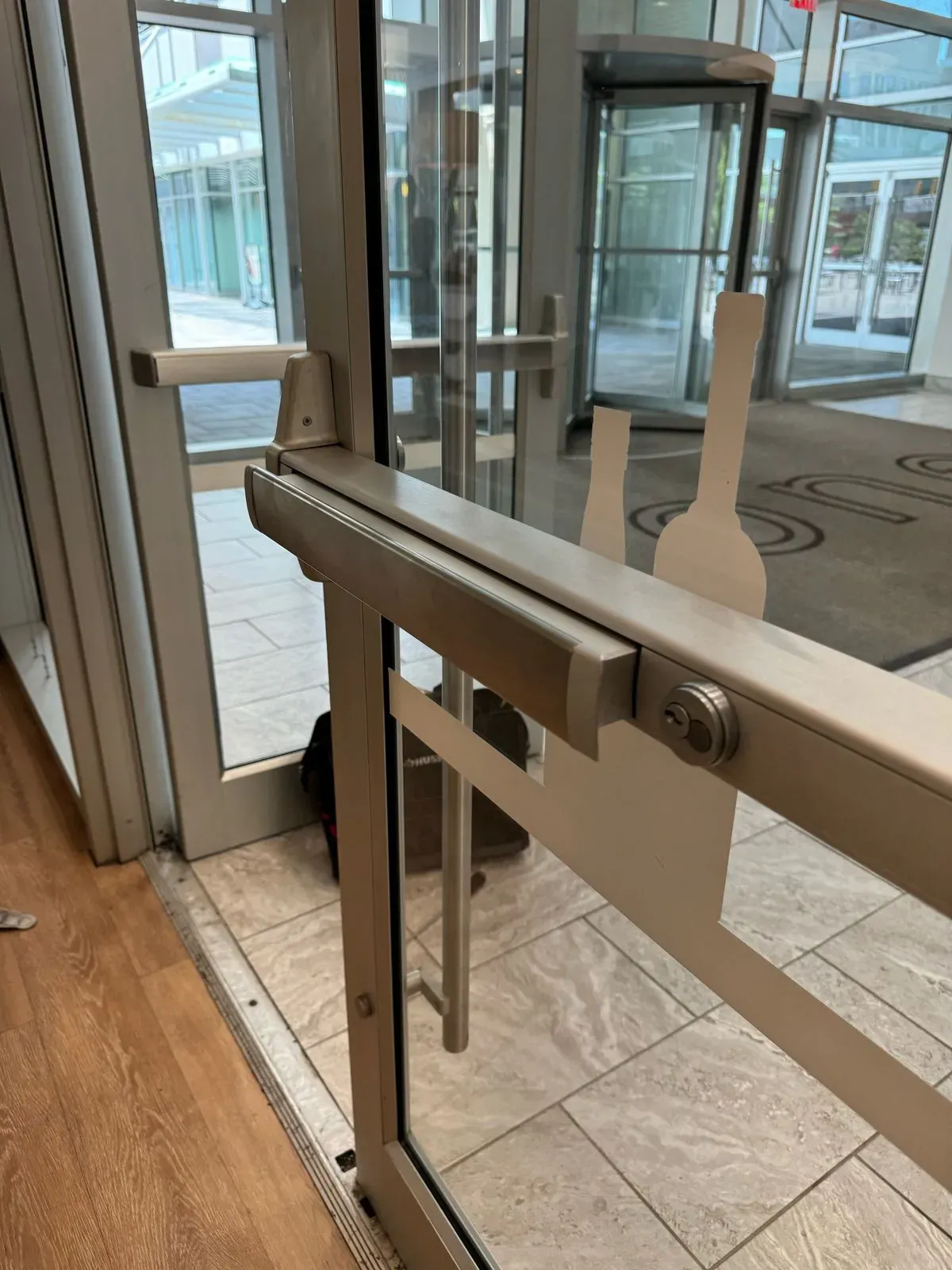
Panic Bar Requirements in NYC: Which Doors Need One
In New York City, a door must use panic hardware instead of any other latch or lock when it serves a Group A or E room or space with an occupant load of 75 or more, a smaller assembly space that the code classifies as Group B, a high-hazard Group H occupancy, or certain electrical and machinery rooms. That is NYC Building Code §1010.1.10. The number most articles quote, 50, comes from the national model code. The city's number for assembly rooms is 75.
That is the short version. Below is what the section actually says, how to tell whether your space reaches 75, what the hardware itself must do, and what you may not do to an exit door at night.
What the NYC Building Code says
The rule is written as a ban on every other kind of latch. Section 1010.1.10 of the 2022 NYC Building Code reads: "Doors serving the following shall not be provided with a latch or lock other than panic hardware or fire exit hardware." Four categories follow:
- Group H occupancies, the high-hazard uses.
- "A room or space with an occupant load of 75 or more in a Group A or E occupancy." Group A is assembly, which covers restaurants, bars, event spaces, gyms and houses of worship; Group E is educational.
- "A building or nonaccessory tenant space used for assembly purposes that is permitted to be classified as a Group B occupancy pursuant to Section 303.1.2."
- An accessory room or space used for assembly purposes that is classified as Group B or as part of the occupancy it serves.
Items 3 and 4 are the ones owners miss. Section 303.1.2 says an assembly space "with an occupant load of fewer than 75 persons shall be classified as a Group B occupancy". Item 3 then pulls those smaller assembly spaces back in. So a door serving a small restaurant or a function room is not off the hook just because the space is classed as business; if that door latches or locks, the latch has to be panic hardware. How the Department of Buildings applies items 3 and 4 to a particular small space is a question for the architect of record or the filing, and it is worth asking before a renovation, not after an inspection.
The rule is about latches, not doors. A door with no latch and no lock is not forced to carry a panic bar, but almost every exterior door latches, and a fire-rated door must.
Rooms that need panic hardware whatever the headcount
Some rooms qualify by what is in them. Section 1010.1.10.1 requires panic or fire exit hardware on exit and exit access doors serving "transformer vaults, rooms designated for batteries or energy storage systems, or modular data centers." It also covers rooms with electrical equipment "rated 800 amperes or more" where the door is "less than 25 feet" from the equipment's working space, and those doors must swing in the direction of exit travel.
Refrigeration machinery rooms have their own section, 1010.1.10.2, with the same rule for swinging doors where the code requires that room to have exits.
How to tell whether your space reaches 75
Occupant load is a calculation, not a count of the busiest night. Section 1004.1.3 divides the floor area by the occupant load factor for the way the space is used, from Table 1004.1.3. The factors that matter for most small businesses:
| Use | Square feet per person |
|---|---|
| Assembly, standing space | 5 net |
| Assembly, chairs only (not fixed) | 7 net |
| Assembly, tables and chairs | 15 net |
| Mercantile, basement and ground floor | 30 gross |
| Mercantile, upper floors | 60 gross |
| Business areas | 100 gross |
| Commercial kitchens | 200 gross |
Some quick arithmetic. A dining room with tables and chairs reaches 75 people at 1,125 net square feet. A standing bar area reaches 75 at just 375 net square feet. Where one space mixes uses, the code calculates each part separately and adds them, under §1004.1.2, so a bar with a standing area and a dining area adds both.
There is a useful cross-check. The same 75 is the line for a Place of Assembly Certificate of Operation: §303.7 requires one for "indoor assembly occupancies used or intended for use by 75 persons or more." If your space has, or needs, a Place of Assembly certificate, assume its exit doors need panic hardware.
What the hardware itself must do
Section 1010.1.10.3 sets four requirements wherever panic or fire exit hardware is installed:
- Panic hardware must be listed to UL 305.
- Fire exit hardware, the version made for fire-rated doors, must be listed to UL 10C and UL 305.
- The push bar or pad must extend across at least half the width of the door leaf.
- It must unlatch with no more than 15 pounds of force.
Mounting height comes from a different section. Section 1010.1.9.2 puts door handles, pulls, latches, locks and other operating devices between 34 and 48 inches above the finished floor.
The practical difference between the two kinds is the fire door. Panic hardware on an ordinary door can often be held open ("dogged") during business hours. Fire exit hardware cannot, because a fire door has to latch every time it closes. Putting ordinary panic hardware on a fire-rated door is a common and expensive mistake.
What you may not do to an exit door
Business owners lock exits for understandable reasons: theft out the back door, a side door that staff prop open. The code does not accept any of them.
- No chains, padlocks or slide bolts on a required exit. The Fire Code makes it "unlawful to obstruct or impede access to any required means of egress" (§1027.2), and requires exits to be "continuously maintained free from obstructions and impediments to immediate use" (§1027.3).
- No extra deadbolt beside the panic bar. On a door covered by §1010.1.10, panic hardware is the only latch or lock allowed.
- No locking staff in. Building Code §1001.3.1 bars an employer from locking the doors of a workplace when that endangers employees in a fire or other emergency.
- Delayed egress locks are mostly off the table. Section 1010.1.9.7 allows them only with special review by the Buildings commissioner, and not at all in Group A, E, F or H spaces, with a narrow exception for museums.
- Magnetic locks come with conditions. Section 1010.1.9.9 allows electromagnetic locks in Group A, B, E, M, R-1 and R-2 spaces when they meet its listed conditions, and where panic hardware is required, operating the panic hardware must also release the magnetic lock. The Fire Code adds that security devices affecting exits are subject to the approval of the Commissioner of Buildings (§1027.3.2).
The FDNY door lock guide covers the residential side of the same principle: anyone inside must be able to get out without a key.
Securing the door at night, legally
Panic hardware does not mean an unlockable door. Exit devices come with outside trim and a keyed cylinder, so the door can be locked against entry from the street while it still opens with one push from inside. A high-security cylinder in that outside trim, $225 to $500 per opening, keeps keys from being copied by whoever worked the last shift.
Roll-down gates are the other half of the storefront picture. A gate that closes over an exit door is fine when the space is empty and a violation when people are inside. The storefront gate guide covers the gate rules.
When the panic bar stops working
The failures we see most are predictable. The latch does not catch, so the door bounces open after closing. Vertical rods on a two-leaf door bend or slip and stop latching at the top or bottom. Dogging sticks, so the door never locks. The device works loose from the door. The outside cylinder wears out after years of shift changes.
Every one of those is a repair, and none of them is solved with a chain. Panic bars and exit devices are part of our commercial locksmith work, including in Manhattan storefronts and offices. Repairs are priced like other lock repair, $125 to $450 per opening, and a new device is quoted with its hardware, because devices vary widely by grade and function. The service call depends on the hour: $60 from 8 a.m. to 6 p.m., $90 from 6 p.m. to 10 p.m., and $125 from 10 p.m. to 8 a.m.
Frequently Asked Questions
Is panic hardware required at 50 people in NYC? Not for Group A and E rooms. The 2022 NYC Building Code sets the threshold at an occupant load of 75 in §1010.1.10. The figure of 50 comes from the national model code, which many articles quote without noting that New York City amends it.
Does my small restaurant need a panic bar? Possibly, even under 75 people. Assembly spaces under 75 are classified as Group B under §303.1.2, and §1010.1.10 still requires panic hardware on doors serving those spaces when the door has a latch or lock. Confirm with your architect or the building's filing.
Can I add a deadbolt to a door that has a panic bar? No. On a door that §1010.1.10 covers, panic or fire exit hardware is the only latch or lock allowed. Lock the door against entry with a keyed cylinder in the exit device's outside trim instead.
What is the difference between panic hardware and fire exit hardware? Fire exit hardware is panic hardware listed for use on fire-rated doors, under UL 10C as well as UL 305. It cannot be held open with dogging, because a fire door must latch every time it closes.
How high does a panic bar have to be mounted? Operating devices go between 34 and 48 inches above the finished floor under §1010.1.9.2, and the push bar must span at least half the door's width under §1010.1.10.3.
Need Expert Help?
If you have questions about any of the security solutions discussed in this article, our team is ready to provide expert guidance.
Call us at (844) 912-1908 for a free consultation or to schedule a service.