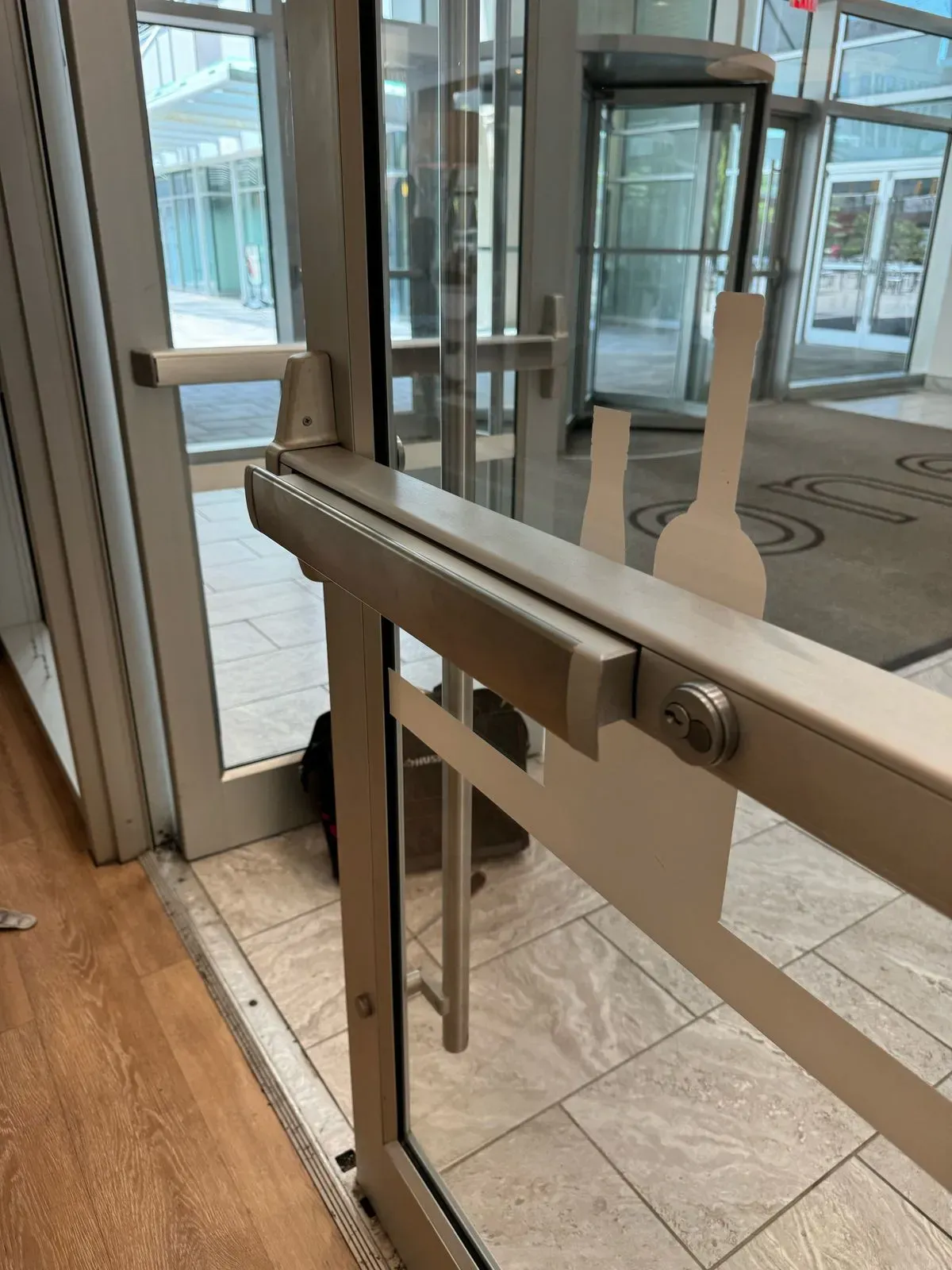
Broken Front Door Lock in Your NYC Building: Who Fixes It
If the front door lock of your NYC apartment building is broken, the owner has to fix it. State law requires apartment buildings put up after 1968 to have automatic self-closing, self-locking entrance doors that stay locked unless an attendant is on duty, and the city's Housing Maintenance Code makes the owner responsible for keeping that hardware working.
HPD treats a broken building entrance lock as serious. Since January 2025 it has written 1,411 violations for a broken or defective lock at a building entrance door, and 82 percent were class C, the most urgent class. This post covers what the law says, how fast the owner has to act, and what you can do tonight.
What the law requires of a building's front door
The rule sits in Multiple Dwelling Law §50-a. For a building erected or converted after 1968, entrances from the street, a passageway, a court, a yard or a cellar must have "automatic self-closing and self-locking doors," and those doors "shall be locked at all times except when an attendant shall actually be on duty."
Two details matter. An entrance that leads to a lobby which already has an automatic self-locking door is exempt, which is why a vestibule door can be unlocked when the inner lobby door is not. And a building with eight or more apartments must also have an intercom at the self-locking door, so each apartment can talk to a visitor and release the lock from inside.
Older buildings work differently. For a building erected or converted before 1968, the requirement depended on tenants occupying a majority of the apartments asking for it or agreeing to it in writing. If you live in a pre-1968 building without a self-locking front door, that history may be the reason. The Buildings Department's rule at 1 RCNY §42-01 sets the same thresholds for the city and adds that a self-locking door must open from the inside without a key.
Who has to fix it
The owner does. Section 27-2005 of the Administrative Code makes the owner responsible for keeping the building in good repair, and a broken entrance lock is a defective component like a dead boiler or a leaking pipe.
Section 50-a puts the duty in the same place. It covers "every owner who shall fail to install and maintain the equipment required by this section." Maintaining includes the lock, the latch, the closer and the strike. It does not matter that the lock "mostly works" or that the building has an intercom that still buzzes. A front door that does not latch is a front door that does not lock.
The same section is equally clear about tenants. It also reaches "any person who shall wilfully destroy, damage, or jam or otherwise interfere" with the equipment. Taping the latch or wedging the door to avoid being locked out is a violation too, even when the intention is harmless.
What HPD's data shows
HPD publishes every violation it writes. Filtered to inspections from January 1, 2025, and queried on October 8, 2026, the open data for building entrance doors reads like this.
| Measure | Count |
|---|---|
| Violations for a broken or defective lock at a building entrance door | 1,411 |
| Class C (immediately hazardous) | 1,161 |
| Class B (hazardous) | 249 |
| Class A | 1 |
| Still open at the time of the query | 613 |
| Records that also mention an electromagnetic locking device | 444 |
The borough split is lopsided. The Bronx accounts for 972 of the 1,411 records, about 69 percent, with Brooklyn at 190, Manhattan at 159, Queens at 72 and Staten Island at 18. That reflects where HPD inspections and complaints land, not where locks fail, so read it as a map of enforcement. The takeaway is simple: the city treats an unlocked front door as a real hazard, and it classifies most of them as immediately hazardous.
How fast the owner has to fix it
The deadline comes from the class. Administrative Code §27-2115(c) sets ninety days from mailing for a non-hazardous violation, thirty days for a hazardous one, and twenty-four hours for an immediately hazardous one.
A broken entrance lock was class C on about four records in five, so the realistic expectation is twenty-four hours, not months. That is the number to hold in mind when a super says it will be looked at next week. A violation that stays open past its deadline can lead to civil penalties against the owner, and a lock that stays broken week after week is the kind of pattern a tenant attorney or HPD can act on.
How to report it, in order
Start by telling the super or management in writing, with the date and a photo, so you have a record that the owner was told. A text or email counts, and a conversation in the hallway does not.
If the lock is not fixed, file a complaint with 311, online or by phone, and give the address and the specific problem: the front door does not latch, or the lock is broken. HPD can send an inspector, and if the inspector sees the defect it writes the violation, which starts the clock. Keep the complaint number. You can look up the building's violations on HPD's public records afterward, and an open class C violation on the front door is useful evidence.
Do not rely on the intercom as proof the door is secure. Check that the door closes and latches by itself every time you come home. A door that swings shut and clicks but does not lock is the commonest failure, and it is the one most likely to be reported as fine.
What not to do
Three things make the situation worse. Do not prop, tape or wedge the door, since §50-a covers anyone who jams the equipment. Do not call a locksmith to change the building's lock yourself, because the entrance hardware belongs to the owner and a lock the owner cannot open during an emergency creates a different safety problem. And do not assume a broken lock is the owner's lowest priority: for a building with a recent break-in or a package-theft problem, the front door is the first fix.
A broken entrance door also feeds into the tenant side of safety, covered in after a break-in: a NYC checklist. If the lock failed and someone got in, document that too.
What a locksmith does once the owner authorizes
When the owner or the managing agent calls, the work is diagnosis before replacement. A door that will not lock can have a worn latch, a misaligned strike, a failing closer that does not pull the door fully shut, or a dead electric strike or magnetic lock. The right fix depends on which, and replacing a whole lock when the strike is the problem is the common overspend.
SwiftLocksmith handles commercial and building entrance hardware, lock installation and repair and the access control systems that release many entrance doors, and property managers can set up a standing arrangement for after-hours failures, a model laid out in lockouts and front-door duties for property managers. When the issue is the intercom and not the lock, buzzer and intercom problems is the right starting point.
Frequently Asked Questions
Who is responsible for fixing a broken building entrance lock in NYC? The owner. The Housing Maintenance Code makes the owner responsible for keeping the building in good repair, and Multiple Dwelling Law §50-a requires the owner to install and maintain self-locking entrance doors in buildings built after 1968.
How long does a landlord have to fix a broken front door lock? It depends on the violation class. HPD writes most broken entrance locks as class C, which carries a twenty-four hour correction deadline. Class B is thirty days and class A is ninety.
How do I report a broken front door lock in an NYC apartment building? Tell management in writing first, with a photo and the date, then file a complaint with 311. HPD can send an inspector and write a violation if it finds the defect.
Does my building have to have a self-locking front door? Buildings built or converted after 1968 do, unless an attendant is on duty. Older buildings were only required to add them if tenants occupying a majority of the apartments asked or agreed in writing.
Can I change the front door lock myself? No. The entrance hardware belongs to the owner. You can report the problem and push for the repair, but changing the building's lock is the owner's decision.
Need Expert Help?
If you have questions about any of the security solutions discussed in this article, our team is ready to provide expert guidance.
Call us at (844) 912-1908 for a free consultation or to schedule a service.