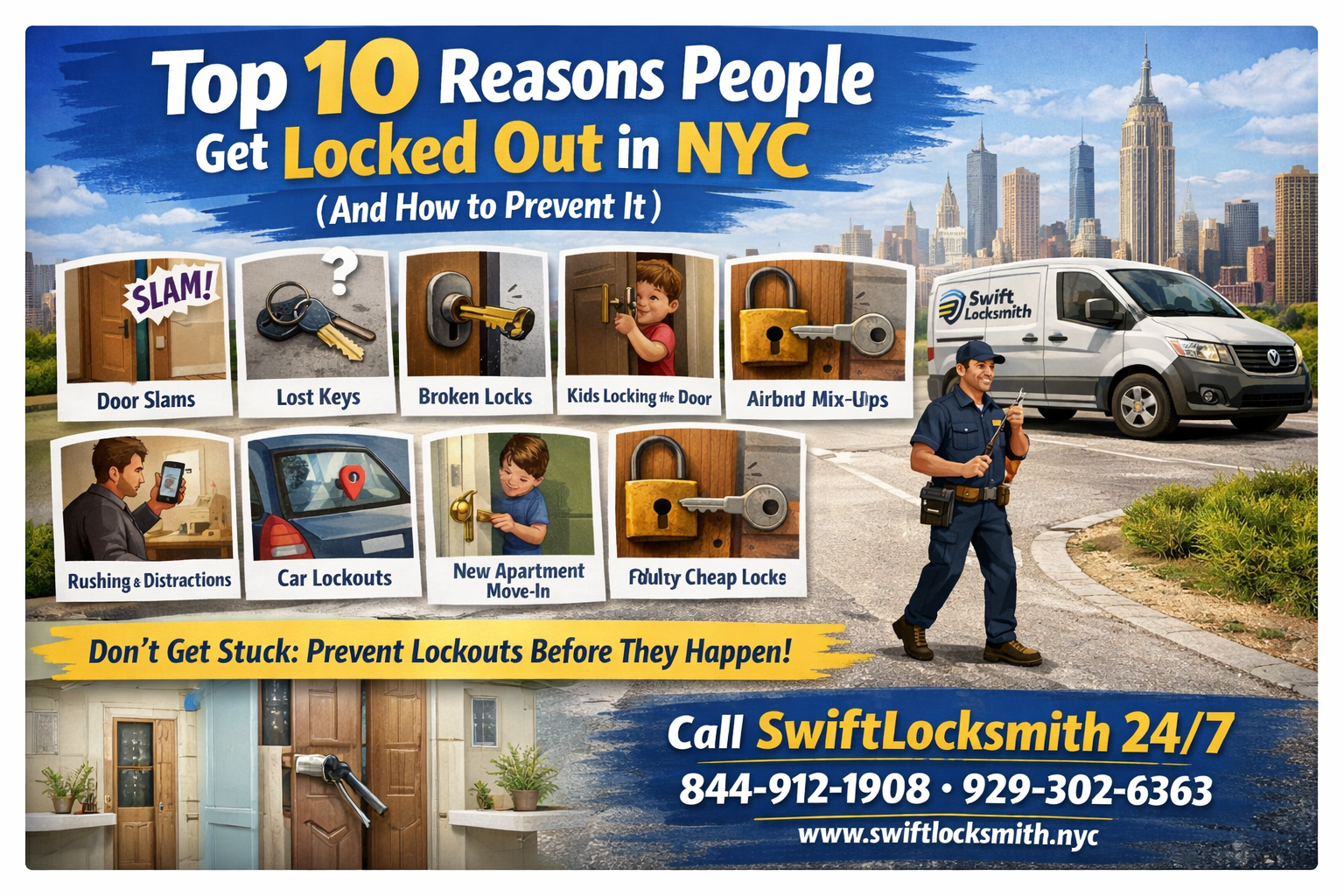
Top 10 Reasons People Get Locked Out in NYC and How to Prevent It
# Top 10 Reasons People Get Locked Out in NYC — and How to Prevent Each One
Lockouts in New York City are rarely dramatic. Nobody plans them. You step into the hallway to grab a package, the apartment door swings shut behind you, and the deadbolt you never think about has quietly locked you out of your own home. Multiply that by 8.3 million people, self-locking doors, brutal winters, and transponder car keys, and you get a city where locksmiths stay busy around the clock.
The good news: almost every lockout has a specific, preventable cause. Here are the ten we see most often across Manhattan, Brooklyn, Queens, and the Bronx — and exactly how to stop each one from happening to you.
## 1. The self-locking apartment door
This is the number-one cause in NYC, and it is not your fault. Most apartment and brownstone doors have a spring-latch that locks automatically when the door closes — no key turn required. Step out for the mail or the trash and you are locked out instantly.
Prevention: Keep a spare key with a trusted neighbor or in a coded lockbox, and never prop the door on a "quick" errand. If you get caught out, an [emergency lockout service](/emergency-lockout-nyc) can usually open a standard apartment door without any damage to the lock.
## 2. Keys left inside in the rush out the door
NYC mornings move fast. Keys get left on the counter, in yesterday's coat, or in the bag you swapped this morning.
Prevention: Build a "wallet, phone, keys" tap-check at the door — the same three-second habit that prevents most lockouts. A hook by the entrance keeps keys in one predictable place.
## 3. A worn key snaps off in the lock
Brass keys wear down. After years of use the cuts round off, and one cold morning the key twists and breaks inside the cylinder — leaving you stuck with half a key and a jammed lock.
Prevention: Replace visibly worn keys *before* they fail, and don't force a sticky lock. If a key does break off, skip the tweezers (they usually push it deeper) and call for [broken-key extraction](/services/broken-key-extraction) so the cylinder isn't damaged.
## 4. Lost or stolen keys
A dropped keyring on the subway, a stolen bag, a set that simply never turns up — and now you are locked out *and* worried about who has access.
Prevention: After losing keys, don't just get a copy made — [rekey the lock](/services/lock-rekeying) so the missing keys no longer work. It's cheaper than a full lock change and restores your security the same day.
## 5. Car keys locked in the car
Manhattan parking is stressful enough without watching the door thunk shut with the fob sitting on the driver's seat. It happens daily in garages, at the curb, and in the long-term lots near LaGuardia and JFK.
Prevention: Keep a spare fob at home and never leave the only key inside while the car runs. If you're stuck, a mobile [car locksmith](/car-locksmith-nyc) opens modern vehicles damage-free — no slim-jims, no scratched paint.
## 6. A dead transponder or key-fob battery
A lot of "my key stopped working" calls are really a dead fob battery. The car won't recognize the key, and push-to-start cars can leave you stranded even with the fob in your hand.
Prevention: Replace the fob battery every couple of years, and keep your physical backup key (hidden inside most fobs) accessible. For a lost or failing chip key, on-site [transponder key replacement](/services/transponder-key-replacement) costs a fraction of the dealership — see our [car key replacement cost guide](/blog/car-key-programming-cost-nyc) for real NYC numbers.
## 7. A roommate or ex moves out — and the locks never change
NYC apartments turn over constantly. When a roommate leaves, a relationship ends, or a sublet wraps up, the old keys are still out there. This isn't a classic "lockout," but it's the security gap that leads to the worst ones.
Prevention: Rekey every time someone with a key moves out. It takes 20 minutes and means only the people you trust can open your door.
## 8. Smart-lock glitches and dead batteries
Smart locks are great until the batteries die at 11 p.m. or a firmware hiccup leaves the keypad unresponsive. Going keyless without a backup is how tech-forward New Yorkers get locked out.
Prevention: Always keep a physical key backup, and swap smart-lock batteries on a schedule instead of waiting for the low-battery chirp. If you're choosing a model, our guide to [keypad and keyless locks](/blog/understanding-different-types-of-locks-a-comprehensive-guide) covers which ones suit NYC doors. Professional [smart-lock installation](/services/smart-lock-installation) also ensures the mechanical override is set up correctly.
## 9. Frozen and seized locks in winter
NYC winters punish exterior locks. Moisture inside the cylinder freezes, or years of grit finally seize the mechanism, and the key won't turn on the coldest morning of the year.
Prevention: Lubricate exterior locks with a graphite or dry-PTFE lubricant before winter — never WD-40, which gums up over time. Never force a frozen lock; a snapped key turns a five-minute thaw into a full lockout.
## 10. Storefronts, gates, and mailboxes after hours
Business owners get locked out too — a jammed storefront gate, a failed commercial cylinder, a mailbox lock that won't budge. These tend to strike at the worst times, like a Sunday open or a 6 a.m. delivery.
Prevention: Service commercial locks and gates on a maintenance schedule instead of running them to failure, and keep duplicate keys with a manager. For recurring issues, a [commercial locksmith](/commercial-locksmith-nyc) can rekey, repair, or upgrade the hardware before it strands you.
## Frequently asked questions
How fast can a locksmith reach me in NYC? For most of Manhattan, Brooklyn, and western Queens, a mobile locksmith arrives in roughly 15–30 minutes. Outer-borough and outer-Queens calls can run a little longer depending on traffic.
Will opening my door damage the lock? For standard apartment and house locks, no. A skilled locksmith picks or bypasses the vast majority of NYC locks without any damage. Drilling is a last resort, and you should be told before it happens.
What does an NYC lockout cost? Expect a starting price around $125 for a standard residential lockout, with the final number depending on the lock type and time of day. A reputable locksmith quotes you before starting — read our [NYC locksmith pricing guide](/blog/how-our-locksmith-pricing-works-at-swiftlocksmith) so the "$65" bait-and-switch never catches you.
Should I rekey or replace my locks? Rekeying is usually the right call — same security, lower cost, no new hardware — unless the lock is damaged or low quality. A locksmith can tell you which you actually need in under a minute.
## Locked out right now?
If you're standing in a hallway reading this, skip ahead to our step-by-step [what to do when you're locked out in NYC](/blog/what-to-do-when-locked-out-in-nyc-a-new-yorker-s-emergency-guide) guide — then call. SwiftLocksmith runs 24/7 across all five boroughs with licensed, insured, Google-Guaranteed technicians and upfront pricing.
Call (844) 912-1908 — we're already nearby.
Need Expert Help?
If you have questions about any of the security solutions discussed in this article, our team is ready to provide expert guidance.
Call us at (844) 912-1908 for a free consultation or to schedule a service.